.png)
We’re in the middle of an epidemic. But it’s not the one you’re thinking of.
- Josh Packard
- Apr 9, 2020
- 2 min read

Updated: Apr 9, 2020
In the months before the emergence of Covid-19, Springtide Research Institute conducted research that revealed troubling trends of social isolation and loneliness among young people (ages 13–25). In fact, those numbers were at an all-time high even before Americans retreated from social gatherings.
The research from Springtide, available in Belonging: Reconnecting America’s Loneliest Generation, confirms what studies by Cigna and others have been finding. Namely, for the first time in history, our youngest generations are more lonely and isolated than any other group of people, and their levels of loneliness and social isolation are at all-time highs. Our research extended those findings down to 13-year-olds, using a nationally representative sample.
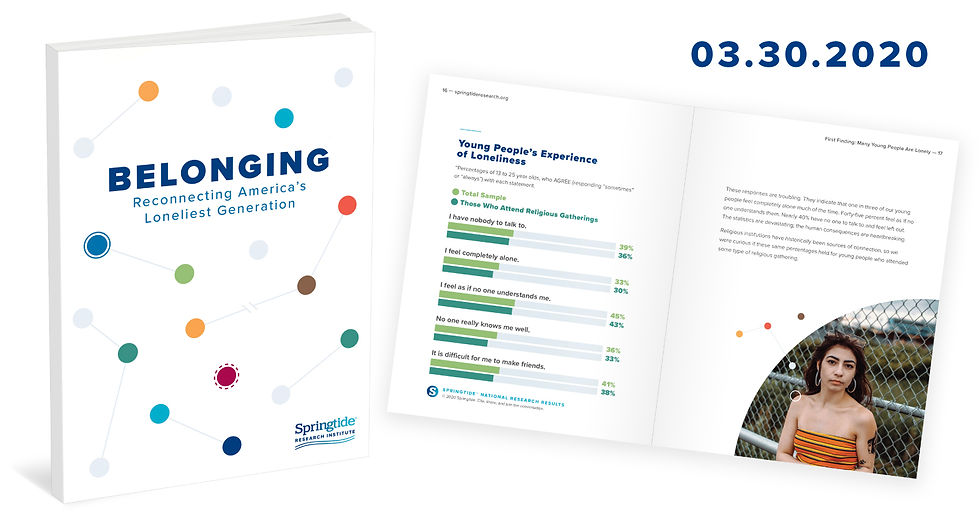

As troubling as those numbers are, they weren’t that shocking given the previous, recent research in this area.
What stunned us was when we started looking into the protective or buffering effects. We wanted to know: What are the antidotes to this social epidemic?
We suspected we would see a distinct difference in experiences of isolation between young people who were involved in religious gatherings as opposed to those who were not. We fully anticipated that this kind of participation would provide both social and existential protections against disconnection and meaninglessness. We analyzed these variables largely as part of our confirmatory process. That’s how sure we were.
We couldn’t have been more wrong.
Attendance at religious gatherings such as worship, Scripture studies, youth groups, prayer groups, meditations, etc., had ZERO protective effects.

We were so stunned by this that I remember asking our research team to run the analysis again (and then again after that). But every time it came back exactly the same. (We have a good research team!).
Searching for answers, we turned to the qualitative data and other questions in the survey. We now had two puzzles. Why are young people so isolated when they appear to be hyperconnected? And why doesn’t attending a group religious gathering make any difference?
Our data revealed a vital connection between the decline of institutional trust and the rising importance of relationships. Attendance doesn’t matter because young people don’t trust institutions. The evidence on this was clear.
However, when that attendance was coupled with a relationship with a trusted adult at that same place, we saw clear buffering effects. We discovered that young people who have a relationship with at least one trusted adult in a religious institution are more trusting, less isolated, less stressed, and more confident about their future.
The implications of this research are clear. In an era of low institutional trust, leaders who work with young people need to move away from institutionally driven programs and start leading with relationships in innovative and sophisticated ways. The old models, once so effective, simply don’t work as the world has shifted around us.
Josh Packard, Ph.D. is the Executive Director of Springtide Research Institute, Associate Professor of Sociology at the University of Northern Colorado, and the Head of Applied Sociology for the Global Center for Religious Research. Find him on twitter @drjoshpackard.


ee88.com mình thấy bạn bè nhắc hoài nên cũng ghé thử cho biết, kiểu vào xem giao diện ra sao thôi chứ không có ngồi mày mò kỹ. Lướt vài phút là mình để ý họ làm bố cục khá dễ thở, nhìn không bị nhồi nhét chữ nên đỡ mỏi mắt. Mình thích nhất là mấy phần nội dung được chia thành khối rõ ràng, kéo xuống là biết đang ở mục nào, không bị lạc. Thanh menu đặt chỗ dễ thấy nên bấm qua lại cũng nhanh, không phải mò trong mấy nút ẩn. Nói chung cảm giác “mới vào mà vẫn dùng được liền” khá ổn, nhìn thân thiện. Mấy bảng thông tin dạng cột trình bày…
trực tiếp bóng đá dạo này thấy nhiều người nhắc nên mình cũng ghé thử Socolive cho biết. Mình không ngồi xem hết trận nào đâu, chủ yếu vào lướt xem trang bố trí ra sao thôi. Cảm giác đầu tiên là giao diện khá dễ chịu, chữ nghĩa rõ ràng, kéo xuống là gặp mấy khối nội dung kiểu giới thiệu tổng quan nên không phải đoán mò. Có lần mình vào đúng lúc chưa có lịch thì nó hiện luôn “Chưa có trận đấu nào”, nhìn thật thà và đỡ mất công bấm tìm. Nói chung vài phút là quen tay, vì các tiêu đề heading trên trang hiển thị nổi và tách bạch, nhìn phát biết mình…
hitclub mình mới lướt thử vì thấy bạn bè nhắc hoài, kiểu tò mò xem trang nhìn ra sao thôi chứ không đào sâu nội dung. Vừa vào cái là thấy giao diện khá dễ chịu, nền thoáng và các phần được chia theo từng khối nên mắt không bị rối. Mình thích nhất là menu đặt ngay chỗ dễ thấy, bấm qua lại giữa các mục nhanh, không phải mò nhiều lớp. Kéo xuống cũng mượt, mỗi đoạn thông tin tách bạch nên đang ở đâu là biết liền. Nói chung cảm giác họ sắp xếp gọn gàng, đọc lướt cũng nắm được ý chính. Mấy bảng thông tin dạng cột nhìn khá gọn và dễ theo dõi trên…
EE88 mình vừa lướt thử cho biết thôi, kiểu xem giao diện có dễ dùng không. Vào cái là thấy trang làm khá gọn, nhìn hiện đại và chia khu vực rõ nên không bị loạn mắt như mấy chỗ nhồi chữ. Mình dùng điện thoại, chuyển qua lại giữa các mục thấy phản hồi nhanh, cuộn xuống cũng mượt chứ không bị giật. Có cái mình để ý là họ trình bày thông tin theo dạng khối, chữ với bảng dữ liệu canh hàng cột khá ngay ngắn nên đọc lướt vẫn nắm được ý chính. Nói chung cảm giác họ ưu tiên trải nghiệm và tốc độ xử lý, nhìn không bị “nặng” dù nội dung nhiều. Menu…
Honestly I’m into posts that don’t overcomplicate things, and this one felt super easy to follow without having to “study” it. I was skimming and still picked up the main idea right away, which is kinda rare. I ended up hopping over to thedriftboss.com in the middle of reading just to see if it matched the vibe, and yeah, it does. The game description is straightforward too—one-button drifting where timing is basically the whole challenge, so you’re not confused about what you’re doing. I also liked that it didn’t feel like a mess of distractions while I was scrolling around. Everything’s broken into short chunks with clear headings, and the “how to play” info sits in its own tidy section…